
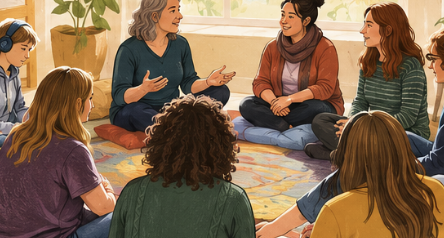
On Saturday 17 October, parents from the home education community gathered at Waymakers' Springstead Community Living Room in Cambridge for a thoughtful and restorative afternoon exploring the power of circles.
The session, The Power of Circles, was led by Caitriona Martin of REAL Circles and offered parents the opportunity to experience circle for themselves, connect with other home educating families and reflect on how circles can help create a sense of community, support, acceptance and empowerment.
For parents who spend much of their time supporting young people's learning, interests and wellbeing, the afternoon also offered something particularly valuable: dedicated time for themselves.
Making space for parents, too
Home educating can be rewarding, but it can also be demanding. Finding time to pause, reflect and connect with other adults can be difficult when so much of everyday life revolves around supporting young people's needs.
Waymakers created this gathering as an opportunity for parents to step away from the usual demands of the day, meet other home educating families and explore something that sits at the heart of its own approach to community.
The session was relaxed and welcoming, with parents able to bring a young person along if they wished. One young person joined us seamlessly, supported by the wonderful Kim of Big Little Yogis to explore Waymakers' resources while the adults took part in the circle.
Having Kim available meant the young person could follow their own interests, knowing that support was there when needed, while the parents had space to engage with the session. It was a lovely reflection of the importance of finding ways for everyone's needs to be considered within a shared space.
Making time for ourselves isn't separate from supporting young people well. Parents need opportunities to recharge, feel connected and reflect on their own experiences, too. Creating those opportunities can help sustain the confidence, energy and sense of perspective that home educating often requires.
Learning to listen differently
With Caitriona's expertise guiding us, we were gradually introduced to the circle process. We took our time settling into the experience before beginning to share, allowing the structure to become familiar rather than rushing.
One of the central practices was listening to each person in turn without interrupting. This meant keeping our mouths firmly shut while someone else was speaking, even when we had a question, a related experience or a thought we were keen to contribute.
Instead, we were invited to give each speaker our attention and allow them to finish and indicate they had done so without being interrupted or redirected.
It sounds simple, but listening without immediately responding takes practice. In everyday conversations, we can be quick to offer advice, reassure someone, share a similar experience or suggest a solution. Often, we do this with the best of intentions. Yet these responses can sometimes take the focus away from the person who is speaking.
The circle gave us the opportunity to try something different: to listen with curiosity and allow another person's experience to stand in its own right.
As we listened, thoughts and connections inevitably bubbled up. Rather than sharing them straight away, we held onto them until the designated time to offer our 'bubbles'. These were the reflections, ideas or responses that had arisen while we were listening. Crucially, we could share a bubble with another person only if they consented to receive it.
This small but significant part of the process brought consent into the conversation in a very practical way. Having something we want to say doesn't automatically mean someone else wants to hear it. Asking first allows the other person to choose, and gives them greater ownership over their own experience.
The session offered a valuable reminder that listening is not simply waiting for our turn to talk. It is an active way of showing respect, building trust and making room for someone else to be heard.
What can circles offer young people?
Towards the end of the afternoon, we zoomed out from our own experience to consider the wider role of circles, including how they are used at Waymakers.
Circles are a flexible, co-created part of Waymakers' consent-based approach. They provide structure and regular opportunities for young people to come together, share space and explore interests and projects as part of a group.
A key part of this is Waymakers' habit phrase:
'What do I and others need?'
This question encourages young people to consider their own needs alongside those of the people around them. It creates opportunities to practise listening, communicating, recognising different perspectives and thinking about how a shared space can work for everyone.
Circles are not about expecting everyone to think alike, agree with one another or participate in exactly the same way. Rather, they offer a framework within which young people can explore how to be part of a community while retaining their own agency.
Our discussion also highlighted an important consideration: speaking in a circle can take courage, and choosing not to speak can take courage, too.
For some young people, talking in front of a group may feel daunting or uncomfortable. Being invited to share does not mean feeling ready to do so, and a young person's silence should not automatically be interpreted as a lack of interest or engagement.
At Waymakers, it is a deeply held value to create opportunities for voices to be heard without making speaking aloud the only acceptable way to participate. Young people may need different ways to communicate, more time to think, the option to pass or the freedom to step away.
Respecting these choices does not mean giving up on the possibility of confidence growing. Instead, it means creating conditions in which confidence can develop at each young person's own pace, without pressure or shame. We have been privileged to see some truly moving examples of this in our groups.
When young people know their boundaries will be respected, they have greater freedom to decide when and how they want to contribute. Participation becomes something they can increasingly choose for themselves, rather than something they feel compelled to perform.
These are important considerations for any community seeking to balance individual needs with the needs of the group.
Taking the learning beyond the circle
For the parents attending, experiencing the circle process offered a practical way to explore ideas that can be difficult to fully appreciate through discussion alone.
We had the opportunity to notice what it felt like to be listened to without interruption, to hold back our own responses while someone else spoke and to ask permission before offering a reflection.
We also had space to consider how these practices might influence our relationships with young people, our home educating communities and the wider spaces we share.
The question 'What do I and others need?' applies just as much to adults as it does to young people. It invites us to notice when we need support, connection or time to ourselves, while remaining curious about what others might need from us.
The afternoon was a reminder that creating a supportive community involves more than bringing people into the same room. It takes thoughtfulness, a willingness to listen and an understanding that people need different things to feel comfortable, included and able to participate.
It also reinforced the importance of making time for ourselves. Parents deserve spaces where they can talk, listen, reflect and connect without being responsible for everyone else's needs for a little while.
A gorgeous afternoon of connection
A huge thank you to Caitriona for guiding us so thoughtfully through the circle experience, to Kim for supporting the young person exploring Waymakers' resources, and to everyone who joined us and contributed to the afternoon.
It was a gorgeous opportunity to bring our home education community together, experience the power of listening and reflect on how we can create spaces where people feel accepted, respected and heard.
Sometimes, making a little space for ourselves can help us return to our everyday lives with fresh perspective. And sometimes, the most valuable thing we can offer one another is not advice or answers, but the time and attention to listen.
Find out more
To explore Caitriona's work and find out more about REAL Circles — Radical Empathy, Authentic Listening — visit her website. Caitriona offers a range of circles, including spaces for home educating families, where adults can connect, share experiences and feel heard without judgement or pressure to take advice.
